Retold in our own words from Rasmus Björn Anderson’s translation of the Younger Edda (Project Gutenberg) · Published 31 October 2026
The wolf grows
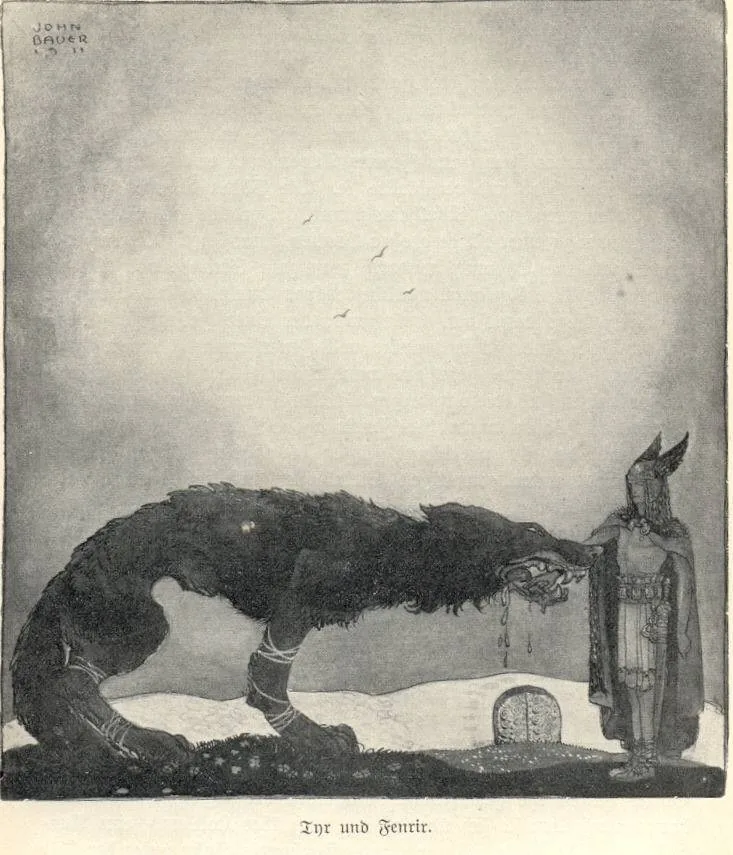
Literature The gods brought up the wolf at home, and Tyr was the only one brave enough to go to him and give him food. Snorri Sturluson, The Younger Edda (the Prose Edda), trans. Rasmus B. Anderson, Project Gutenberg ↗
Literature The wolf grew bigger every day, and the prophecies said he would bring ruin to the gods. So they made a very strong fetter called Lading. Snorri Sturluson, The Younger Edda (the Prose Edda), trans. Rasmus B. Anderson, Project Gutenberg ↗
Literature The wolf burst Lading at once. The gods made a second fetter, half as strong again, called Drome. The wolf broke loose out of that too. Snorri Sturluson, The Younger Edda (the Prose Edda), trans. Rasmus B. Anderson, Project Gutenberg ↗
Tradition The Younger Edda says that ‘to get loose out of Lading’ or ‘to dash out of Drome’ became a proverb for anything extraordinarily hard. Snorri Sturluson, The Younger Edda (the Prose Edda), trans. Rasmus B. Anderson, Project Gutenberg ↗
Gleipner
Literature Then dwarfs made a fetter called Gleipner out of six things: the footfall of cats, the beard of woman, the roots of the mountain, the sinews of the bear, the breath of the fish and the spittle of the birds. Snorri Sturluson, The Younger Edda (the Prose Edda), trans. Rasmus B. Anderson, Project Gutenberg ↗
Literature Gleipner was smooth and soft as a silken string. The wolf suspected a trick, and would only let it be put on him if one of the gods laid a hand in his mouth as a pledge. Snorri Sturluson, The Younger Edda (the Prose Edda), trans. Rasmus B. Anderson, Project Gutenberg ↗
Tyr’s hand
Literature The gods looked at one another. No one offered, until Tyr held out his right hand and laid it in the wolf’s mouth. Snorri Sturluson, The Younger Edda (the Prose Edda), trans. Rasmus B. Anderson, Project Gutenberg ↗
Literature The more the wolf strained, the tighter the band grew. All the gods laughed except Tyr: he lost his hand. Snorri Sturluson, The Younger Edda (the Prose Edda), trans. Rasmus B. Anderson, Project Gutenberg ↗
Literature Since the wolf bit off his hand, Tyr is one-handed. Snorri Sturluson, The Younger Edda (the Prose Edda), trans. Rasmus B. Anderson, Project Gutenberg ↗
Tradition According to the Younger Edda, a very brave person was called ‘Tyr-strong’, and a very clever one ‘Tyr-learned’. Snorri Sturluson, The Younger Edda (the Prose Edda), trans. Rasmus B. Anderson, Project Gutenberg ↗
Follow the thread
Snorri Sturluson, The Younger Edda (the Prose Edda), trans. Rasmus B. Anderson, Project Gutenberg ↗
Retellings are in our own words. Every sentence above carries a label (History, Literature or Tradition) and a link to the source it was checked against. A legend is not a historical record.
Source method & more reading ↗