Retold in our own words from Rasmus Björn Anderson’s translation of the Younger Edda (Project Gutenberg) · Published 31 October 2026
The horn
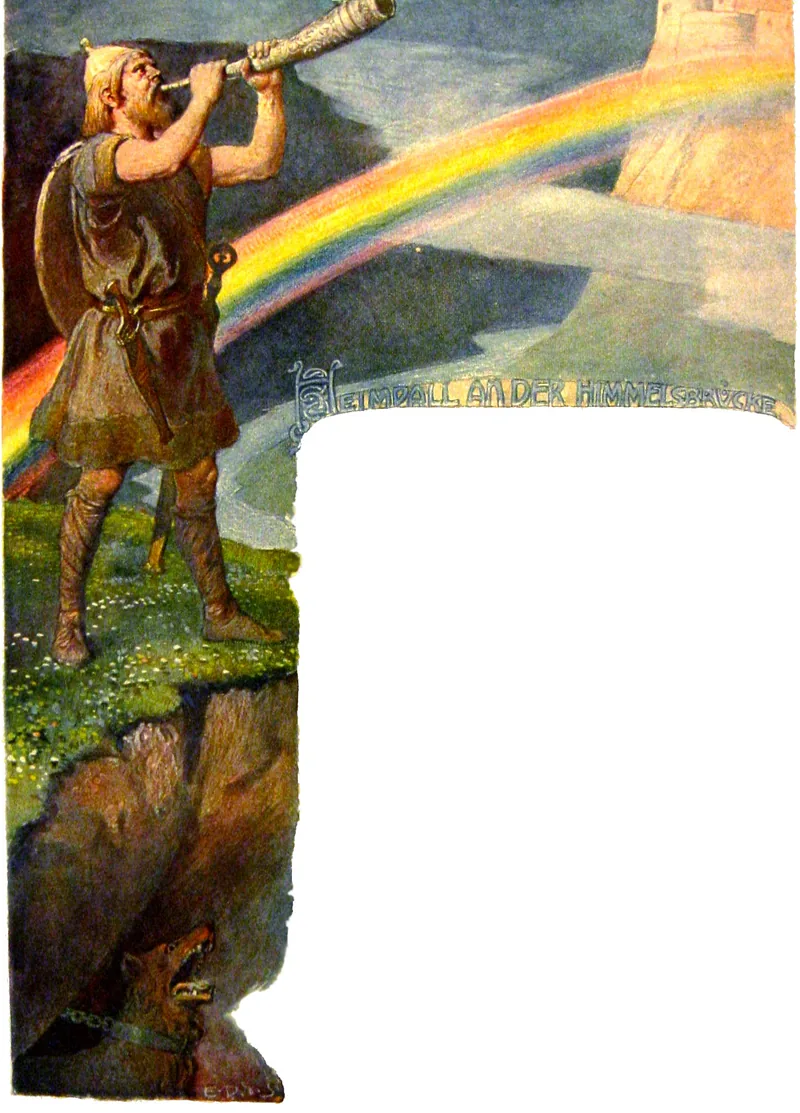
Literature First comes the Fimbul-winter: three winters in a row, with no summer in between. Snorri Sturluson, The Younger Edda (the Prose Edda), trans. Rasmus B. Anderson, Project Gutenberg ↗
Literature Heimdal stands up and blows the Gjallar-horn with all his might, and wakes all the gods. Snorri Sturluson, The Younger Edda (the Prose Edda), trans. Rasmus B. Anderson, Project Gutenberg ↗
Literature Heimdal needs less sleep than a bird, sees a hundred miles around him by night as well as by day, and hears the grass grow. Snorri Sturluson, The Younger Edda (the Prose Edda), trans. Rasmus B. Anderson, Project Gutenberg ↗
Literature Heimdal’s trumpet is the Gjallarhorn: when he blows it, it can be heard in all the worlds. Snorri Sturluson, The Younger Edda (the Prose Edda), trans. Rasmus B. Anderson, Project Gutenberg ↗
History Manx National Heritage says Heimdall’s horn, Gjallarhorn, is pronounced ‘yahl-lahr-hawrn’. Manx National Heritage: Learning about the Manx Crosses ↗
Odin and the wolf
Literature Odin rides first, with his golden helmet and his spear Gungner, against the Fenris-wolf. Snorri Sturluson, The Younger Edda (the Prose Edda), trans. Rasmus B. Anderson, Project Gutenberg ↗
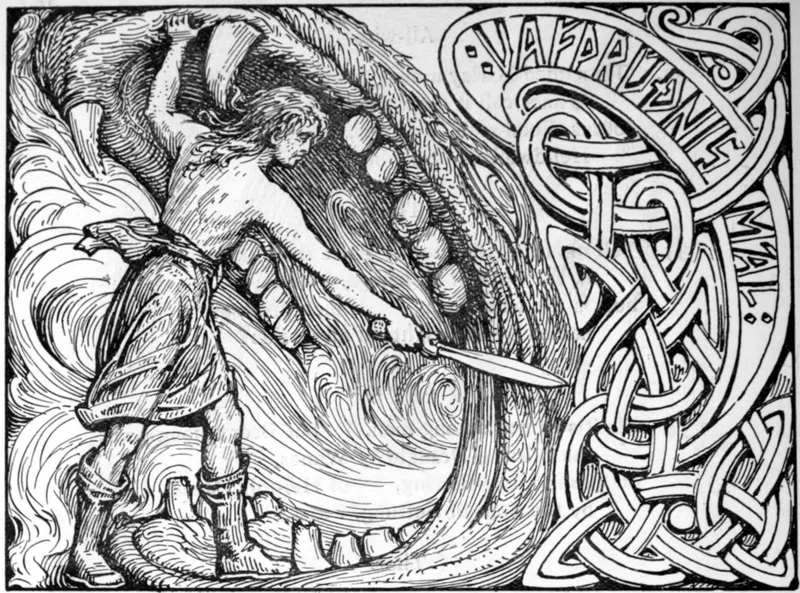
Literature The wolf swallows Odin. But Vidar, the Silent, sets his foot on the wolf’s lower jaw, seizes the upper one with his hand, and tears the wolf apart. Snorri Sturluson, The Younger Edda (the Prose Edda), trans. Rasmus B. Anderson, Project Gutenberg ↗
Literature Vidar is the silent god. He has a very thick shoe, and he is the strongest after Thor. Snorri Sturluson, The Younger Edda (the Prose Edda), trans. Rasmus B. Anderson, Project Gutenberg ↗
The new world
Literature Afterwards the earth rises again from the sea, green and fair, and fields that nobody sowed grow harvests. Snorri Sturluson, The Younger Edda (the Prose Edda), trans. Rasmus B. Anderson, Project Gutenberg ↗
Literature Vidar and Vale live. Thor’s sons Mode and Magne have his hammer Mjolner, and Balder and Hoder come back from Hel. Snorri Sturluson, The Younger Edda (the Prose Edda), trans. Rasmus B. Anderson, Project Gutenberg ↗
Literature Two people, Lif and Lifthraser, hide in Hodmimer’s-holt and live on the morning dew. From them, the whole world fills with people again. Snorri Sturluson, The Younger Edda (the Prose Edda), trans. Rasmus B. Anderson, Project Gutenberg ↗
Ragnarok on a Manx cross
History Manx National Heritage describes one face as a scene from Ragnarok: Odin, one of his ravens on his shoulder, stabs at the wolf Fenrir with his spear, as the beast grips him in its jaws. iMuseum (Manx National Heritage): Replica of Thorwald’s cross ↗
History The Isle of Man Guide describes Odin plunging his spear into the breast of the Fenris Wolf, and adds: ‘afterwards comes Vidar the silent, son of Odin’. Isle of Man Guide: Thorwald’s Cross-Slab (no. 128), Kirk Andreas ↗
A carving on a stone in Andreas and a story in an Icelandic book of the 1200s may be two tellings of the same tradition. The Thorwald’s Cross guide sets out what Manx National Heritage and other writers say.
Follow the thread
Snorri Sturluson, The Younger Edda (the Prose Edda), trans. Rasmus B. Anderson, Project Gutenberg ↗
Manx National Heritage: Learning about the Manx Crosses ↗
iMuseum (Manx National Heritage): Replica of Thorwald’s cross ↗
Isle of Man Guide: Thorwald’s Cross-Slab (no. 128), Kirk Andreas ↗
Retellings are in our own words. Every sentence above carries a label (History, Literature or Tradition) and a link to the source it was checked against. A legend is not a historical record.
Source method & more reading ↗