Retold in our own words from Rasmus Björn Anderson’s translation of the Younger Edda (Project Gutenberg) · Published 31 October 2026
The well of Mimer
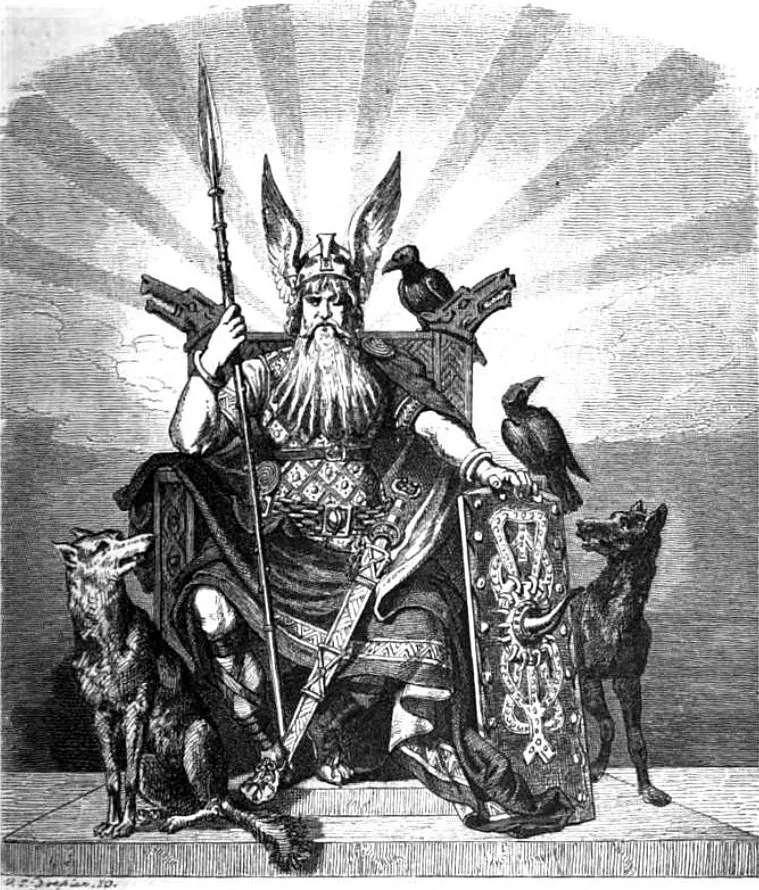
Literature Under one root of the great ash tree Ygdrasil lies the well of Mimer. Knowledge and wisdom are hidden in it. Snorri Sturluson, The Younger Edda (the Prose Edda), trans. Rasmus B. Anderson, Project Gutenberg ↗
Literature Mimer is full of wisdom, because he drinks from the well with the Gjallar-horn. Snorri Sturluson, The Younger Edda (the Prose Edda), trans. Rasmus B. Anderson, Project Gutenberg ↗
Literature Odin once came to the well and asked for a drink. He did not get it until he left one of his eyes there as a pledge. Snorri Sturluson, The Younger Edda (the Prose Edda), trans. Rasmus B. Anderson, Project Gutenberg ↗
Hugin and Munin
Literature Two ravens sit on Odin’s shoulders and bring to his ears all that they hear and see. Their names are Hugin and Munin. Snorri Sturluson, The Younger Edda (the Prose Edda), trans. Rasmus B. Anderson, Project Gutenberg ↗
Literature At dawn Odin sends them out to fly over the whole world, and they come back at breakfast time. Snorri Sturluson, The Younger Edda (the Prose Edda), trans. Rasmus B. Anderson, Project Gutenberg ↗
Literature That is how Odin learns about so many things, and why he is called Rafnagud, the raven-god. Snorri Sturluson, The Younger Edda (the Prose Edda), trans. Rasmus B. Anderson, Project Gutenberg ↗
Literature In a poem quoted in the Younger Edda, Odin says of his ravens: ‘I fear for Hugin that he may not return, yet more am I anxious for Munin.’ Snorri Sturluson, The Younger Edda (the Prose Edda), trans. Rasmus B. Anderson, Project Gutenberg ↗
Odin’s horse and the world tree
Literature Odin’s horse Sleipner is the best of the gods’ horses, and he has eight feet. Snorri Sturluson, The Younger Edda (the Prose Edda), trans. Rasmus B. Anderson, Project Gutenberg ↗
Literature A poem in the Younger Edda calls the Ygdrasil ash ‘the foremost of trees’, and Odin’s horse Sleipner the best of steeds. Snorri Sturluson, The Younger Edda (the Prose Edda), trans. Rasmus B. Anderson, Project Gutenberg ↗
Odin on the Isle of Man
Tradition Manx National Heritage writes: ‘Legend has it that Odin gave his eye for the gift of wisdom!’ Manx National Heritage: Learning about the Manx Crosses ↗
History Manx National Heritage describes Odin as a god of war, battle, victory and death, and also of magic, poetry, fortune-telling and knowledge. Manx National Heritage: Learning about the Manx Crosses ↗
History Manx National Heritage asks: ‘Can you see Odin and his raven in Thorwald’s Cross?’ Manx National Heritage: Learning about the Manx Crosses ↗
Manx National Heritage tells the eye story as legend, and so do we. The Younger Edda is a book written down in Iceland in the 1200s, not a record of anything that happened.
Follow the thread
Snorri Sturluson, The Younger Edda (the Prose Edda), trans. Rasmus B. Anderson, Project Gutenberg ↗
Manx National Heritage: Learning about the Manx Crosses ↗
Retellings are in our own words. Every sentence above carries a label (History, Literature or Tradition) and a link to the source it was checked against. A legend is not a historical record.
Source method & more reading ↗